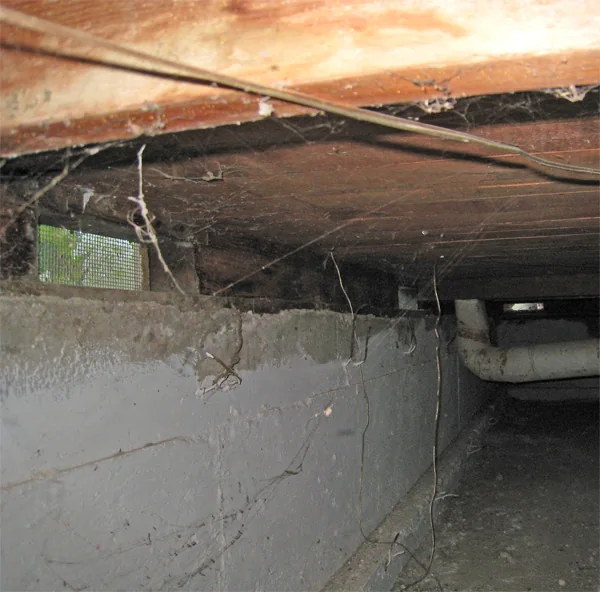
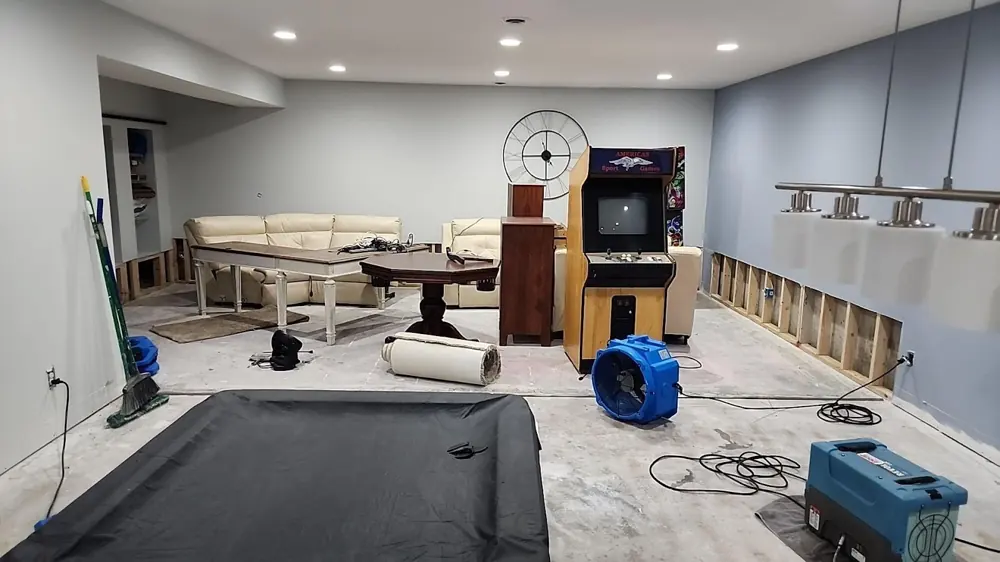
A raised-foundation home in San Jose can have a wet crawlspace for weeks without anyone knowing, until a musty smell or a soft floor gives it away. Crews respond 24/7 and are typically on site within the hour to extract and dry it out.

A crew arrives within about an hour and inspects the crawlspace access point to assess standing water and safety before entry.
Submersible pumps and wet vacuums clear standing water from the crawlspace floor.
Saturated subfloor insulation and any damaged vapor barrier are identified and removed where they cannot be dried in place.
Dehumidifiers and air movers are staged in the crawlspace until moisture readings in the soil, framing, and subfloor confirm it is dry.

While help is on the way, these first steps, done only where it is safe, limit the damage and protect the insurance claim.
Shut the supply off at the source, or close the home's main valve if the source is not obvious. Stopping the flow limits the damage more than anything else.
Switch off electricity to the affected area, but only if the breaker can be reached without standing in or touching the water.
Get a crew dispatched right away. The sooner extraction and drying begin, the more flooring, drywall, and belongings can be saved.
Take photos and a short video of the water and the affected rooms before anything is moved, so the insurance claim starts strong.
Crawlspace water removal in San Jose typically runs from about $600 to $3,000, depending on the size of the crawlspace, how much standing water accumulated, and how much subfloor insulation and vapor barrier has to be replaced. A shallow, quickly found intrusion sits on the low end; a crawlspace that sat wet for weeks with soaked insulation throughout sits on the high end. Coverage depends on the cause, since sudden plumbing failures are commonly covered while chronic groundwater seepage often is not.
Crews reach San Jose, Santa Clara County, and the nearby South Bay fast, from Downtown, Willow Glen, and Rose Garden to Japantown, North San Jose, Santa Clara, Campbell, and Milpitas. See the full list on the areas served across San Jose page.
See all areas servedEvery loss is photographed, measured, and logged from the first visit, so the paperwork holds up with the insurance carrier.
Technicians follow recognized IICRC drying standards and prove it with daily moisture readings on San Jose homes, not guesswork.
Emergency dispatch any hour of the day or night, with a real crew on the way across the South Bay, not a callback in the morning.
A real crew dispatched any hour, not a callback in the morning.
Trained technicians following recognized IICRC drying standards.
Truck-mounted, portable, and submersible for any size loss.
The loss is documented and billed to the carrier directly.
Common signs include a musty smell inside the home, a floor that feels soft or bouncy, higher indoor humidity, or visible moisture near the crawlspace access point. Many homeowners only find out during an unrelated inspection.
The most common causes are a leaking supply line running through the space, poor perimeter grading or drainage that lets rainwater pool against the foundation, and groundwater rising during a wet winter.
Yes, over time. Persistent moisture in the crawlspace can soak subfloor insulation and framing, which can lead to soft spots, warped flooring, and musty odors in the living space above.
It depends on the cause. Sudden plumbing failures are commonly covered, while ongoing groundwater seepage or poor drainage is often treated as a maintenance issue and excluded.
Sections that were submerged or damaged during the water event are generally replaced, since a torn or saturated vapor barrier does not keep ground moisture out effectively.
San Jose crews are on call 24 hours a day, local and fast, and can be on the way within the hour.
Call (669) 587-9723