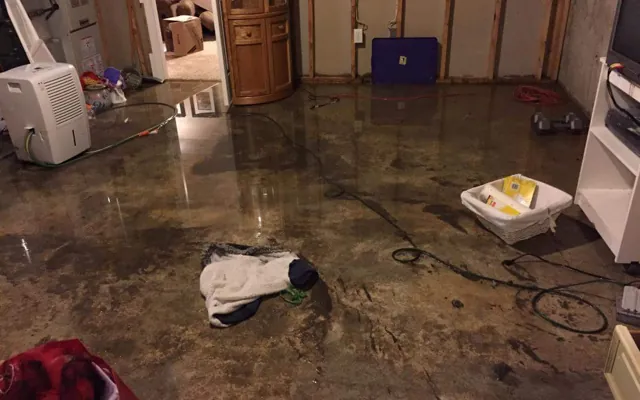
A failed water heater can empty forty or more gallons across a garage floor or a closet and the rooms nearby before anyone notices. Crews respond 24/7 and are typically on site within the hour to extract water and check for hidden spread.

A crew arrives within about an hour and confirms the water supply to the heater has been shut off before cleanup begins.
Pumps and wet vacuums clear water from the garage, closet, or utility area and any adjoining rooms it reached.
Baseboards and door thresholds where water crossed into living space are checked and opened if needed to release trapped moisture.
Meters confirm how far water traveled, then drying equipment runs until readings show the affected materials are dry.

While help is on the way, these first steps, done only where it is safe, limit the damage and protect the insurance claim.
Shut the supply off at the source, or close the home's main valve if the source is not obvious. Stopping the flow limits the damage more than anything else.
Switch off electricity to the affected area, but only if the breaker can be reached without standing in or touching the water.
Get a crew dispatched right away. The sooner extraction and drying begin, the more flooring, drywall, and belongings can be saved.
Take photos and a short video of the water and the affected rooms before anything is moved, so the insurance claim starts strong.
Water heater leak cleanup in San Jose typically runs from about $400 to $2,500, depending on how much water the tank released, whether it stayed on a garage slab or reached interior flooring, and how much drywall or baseboard has to be opened. A contained garage spill sits on the low end; a leak that wicked into an adjoining hallway or bedroom sits on the high end. Sudden tank failures are commonly covered by homeowner insurance, and moisture documentation supports the claim.
Crews reach San Jose, Santa Clara County, and the nearby South Bay fast, from Downtown, Willow Glen, and Rose Garden to Japantown, North San Jose, Santa Clara, Campbell, and Milpitas. See the full list on the areas served across San Jose page.
See all areas servedEvery loss is photographed, measured, and logged from the first visit, so the paperwork holds up with the insurance carrier.
Technicians follow recognized IICRC drying standards and prove it with daily moisture readings on San Jose homes, not guesswork.
Emergency dispatch any hour of the day or night, with a real crew on the way across the South Bay, not a callback in the morning.
A real crew dispatched any hour, not a callback in the morning.
Trained technicians following recognized IICRC drying standards.
Truck-mounted, portable, and submersible for any size loss.
The loss is documented and billed to the carrier directly.
Most tank water heaters last roughly eight to twelve years before corrosion or fitting failure becomes a real risk, though water quality and maintenance can shift that range.
It depends on how much water was involved and where it traveled. A small contained puddle on a garage slab may just need to be mopped up, but any water that crossed into living space or sat for hours is worth having checked for hidden moisture.
A minor fitting or valve leak can sometimes be repaired, but a corroded tank generally needs full replacement, which is typically handled by a plumber separately from the water damage cleanup.
Sudden tank failures are commonly covered under a standard homeowner policy. Gradual leaks that went unaddressed for a long period may be treated differently, so documenting when the leak was discovered matters.
Moisture meters are used along baseboards and door thresholds near the leak to confirm whether water traveled into the wall or under adjoining flooring, so only the areas that are actually wet get opened.
San Jose crews are on call 24 hours a day, local and fast, and can be on the way within the hour.
Call (669) 587-9723